
Mental math games
Easy (within 20) · Medium (within 100) · Hard (within 1,000, × and ÷) · Adult
FreeNo sign-upNo ads in the gamePrint
Grades 2-5 · Common Core 2.OA.B.2, 2.NBT.B.8, 3.NBT.A.2 (mental strategies) · England: mental methods, Years 2-6
Step by step
"Five mental math strategies"
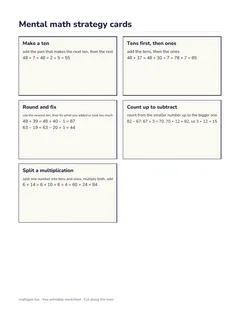
- Make a ten: 48 + 7 = 48 + 2 + 5 = 55.
- Tens first, then ones: 48 + 37 = 48 + 30 + 7 = 78 + 7 = 85.
- Round and fix: 48 + 39 = 48 + 40 − 1 = 87; 63 − 19 = 63 − 20 + 1 = 44.
- Count up to subtract: 82 − 67 → 67 + 3 = 70, + 12 = 82, so 15.
- Split a multiplication: 6 × 14 = 6 × 10 + 6 × 4 = 60 + 24 = 84.

Medium · within 100 · 60-second round ·
- 1none
- 2Speed"
Worksheets to print
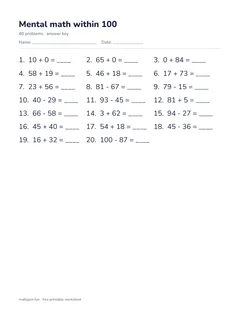
Mental math within 100
40 problems · answer key
While it prints: play Mental math games
Mental math strategy cards
answer key
While it prints: play Mental math games

Mental math games that train real strategies
Mental math, short for mental mathematics (mental maths in the UK), means calculating in your head, without paper or a calculator. It is not a talent; it is a set of strategies that get faster with practice. The mental math games on this page, made for children in 1st to 5th grade, train those strategies with short, timed rounds: make a ten, add the tens first, round and fix, count up to subtract, split a multiplication. Pick a level, press Play, and see how many problems you can solve in 60 seconds: a quick mental math quiz against your own best. For calm practice without a timer, switch to the trainer.
Mental math in school
In the US, mental strategies run through the Common Core from 1st grade on: 2nd graders add and subtract within 20 using mental strategies and mentally add or subtract 10 or 100 to a number like 345; 3rd graders add and subtract within 1,000 using place value. In England mental arithmetic is taught every year from Year 2 to Year 6, through KS1 and KS2, alongside the written methods. Children who are good at mental calculation also make fewer mistakes on paper, because they can tell when a written answer is far off. Short mental arithmetic tests are common in class, and the speed test here is good training for them.
Which strategy for which problem?
For 48 + 7, make a ten. For 63 − 19, round 19 to 20 and give one back. For 82 − 67, count up from 67. Multiplying works the same way: 6 × 14 is 60 + 24. There is rarely one right way; the game accepts any answer reached, and the strategy card above shows the options. Ask your child which way they used - explaining a strategy makes it stick.
Levels for every age, also for adults
"Easy" stays within 20 for 1st and 2nd graders. "Medium" works within 100, the core of 2nd and 3rd grade. "Hard" adds numbers within 1,000 and quick multiplication and division. "Adult" uses a calm design without the cartoon cat, bigger digits and the Hard mix - good for parents who want to race their kids, or for anyone who wants to keep their head for numbers in shape. A new set of problems comes with every round, so no two races are alike. For paper practice, print the mental math sheets: 40 quick problems with an answer key, and the strategy cards.
A tip for parents
Shopping is the best mental math lesson: "This costs $3.99 and that $2.99 - about how much together?" Rounding to $4 and $3 gives $7, minus 2 cents: $6.98.
Questions and answers
How can my child get better at mental math?
Learn a few strategies (make a ten, round and fix) and use them in short daily rounds. Speed comes from practice, not from pressure.
Are mental math games good for adults?
Yes. The adult level has a calm design and the Hard problems; many adults use it as a daily brain warm-up.
Should my child use fingers?
For the easiest level it's fine at the start. The goal of the strategies is to need fewer counting steps.