
Addition with regrouping (carrying)
FreeNo sign-upNo ads in the gamePrint
Grades 2-4 · Common Core 2.NBT.B.5, 2.NBT.B.7, 3.NBT.A.2, 4.NBT.B.4 · England: Year 3 (columnar addition)
Step by step
- Example 1: 47 + 38
- Write the numbers in columns: tens under tens, ones under ones.
- Add the ones: 7 + 8 = 15. 15 is 1 ten and 5 ones.
- Write 5 in the ones column and carry the 1 ten to the top of the tens column.
- Add the tens: 1 + 4 + 3 = 8. Write 8.
- Answer: 47 + 38 = 85. Check: 85 − 38 = 47.
- Example 2: 347 + 285
- Ones: 7 + 5 = 12. Write 2, carry the 1.
- Tens: 1 + 4 + 8 = 13. Write 3, carry the 1.
- Hundreds: 1 + 3 + 2 = 6. Write 6.
- Answer: 347 + 285 = 632.

2-digit addition with regrouping · 10 questions · no timer ·
- 1Practice
- 2Speed
- 3Test
- 4Diploma
Worksheets to print
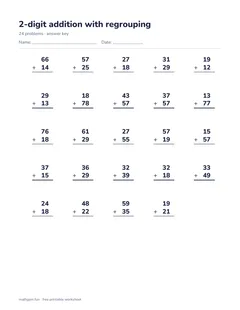
2-digit addition with regrouping
24 problems · answer key
While it prints: play Addition with regrouping
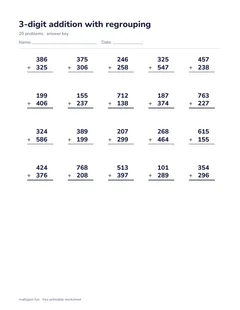
3-digit addition with regrouping
20 problems · answer key
While it prints: play Addition with regrouping
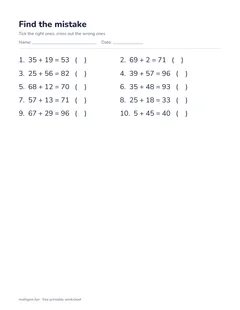
Find the mistake
10 problems · answer key
While it prints: play Addition with regrouping

What is addition with regrouping?
Addition with regrouping is the US school name for what many parents learned as "carrying". When the digits in one column add up to 10 or more, ten of them are regrouped into one unit of the next column: ten ones become one ten, ten tens become one hundred. In 47 + 38, the ones make 15, so 10 ones turn into 1 ten (the small 1 written above the tens) and 5 ones stay. The worked example above shows each step, and the game checks every one of them.
When children learn carrying
The Common Core introduces two-digit addition in 2nd grade with strategies based on place value (base-ten blocks, drawings, number lines), extends it to three-digit numbers within 1,000, and asks for the standard written algorithm by 4th grade. In England, pupils learn the formal column method for addition in Year 3. So a 2nd grader may "carry" with blocks first, and a 3rd or 4th grader writes the little 1 above the column.
The two most common mistakes
Forgetting to add the carried 1 (47 + 38 = 75), and writing the whole 15 in the ones column (47 + 38 = 715). Both come from rushing the ones step. The "find the mistake" worksheet trains children to spot them, and estimating first (50 + 40 = 90) catches them too.
2 digit addition with regrouping: games and worksheets
The trainer shows the problem vertically and asks for the answer on the keypad; every problem really needs a carry, so this is focused practice, not luck. For 2-digit addition without regrouping, or a mix with and without regrouping, use the within 100 game. Double digit addition with regrouping comes first; switch to three-digit (triple digit) numbers in the settings when two-digit problems are easy. The column calculator checks each digit and shows the carry step by step. Print the 2-digit or 3-digit sheets on squared grids, so the columns stay straight, each with an answer key.
A tip for parents
If the school uses "regrouping" and you learned "carrying", use the school word with your child but explain it with money: ten pennies are traded for a dime. Ask your child to say "trade ten ones for one ten" while writing the 1.
Questions and answers
Is regrouping the same as carrying?
Yes. "Regrouping" is the word most US schools use now; "carrying" is the older word for the same step.
What grade learns addition with regrouping?
It starts in 2nd grade and continues in 3rd; the standard algorithm is expected by 4th grade. In England it is Year 3.
Why does my child write the 1 on top?
It is the ten (or hundred) made from the ones that added up to 10 or more. It must be added in the next column.
How can my child check the answer?
Subtract one number from the result: 85 − 38 should give 47.