
Subtraction with regrouping (borrowing)
FreeNo sign-upNo ads in the gamePrint
Grades 2-4 · Common Core 2.NBT.B.5, 2.NBT.B.7, 3.NBT.A.2, 4.NBT.B.4 · England: Year 3 (columnar subtraction)
Step by step
- Example 1: 52 − 27
- Ones: 2 − 7 doesn't work, there are not enough ones.
- Borrow 1 ten from the 5 tens: cross out 5, write 4. The 2 ones become 12 ones.
- Ones: 12 − 7 = 5. Write 5.
- Tens: 4 − 2 = 2. Write 2.
- Answer: 52 − 27 = 25. Check: 25 + 27 = 52.
- Example 2 (across a zero): 403 − 168
- Ones: 3 − 8 doesn't work, and there are 0 tens to borrow from.
- Borrow 1 hundred: 4 hundreds become 3 hundreds, 0 tens become 10 tens.
- Borrow 1 ten: 10 tens become 9 tens, 3 ones become 13 ones.
- Ones: 13 − 8 = 5. Tens: 9 − 6 = 3. Hundreds: 3 − 1 = 2.
- Answer: 403 − 168 = 235. Check: 235 + 168 = 403.

2-digit subtraction with regrouping · 10 questions · no timer ·
- 1Practice
- 2Speed
- 3Test
- 4Diploma
Worksheets to print
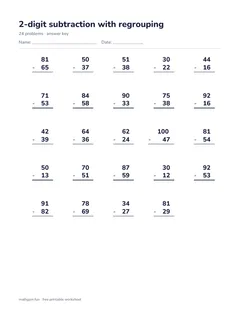
2-digit subtraction with regrouping
24 problems · answer key
While it prints: play Subtraction with regrouping
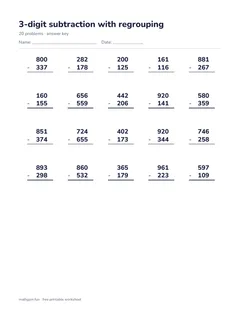
3-digit subtraction with regrouping
20 problems · answer key
While it prints: play Subtraction with regrouping
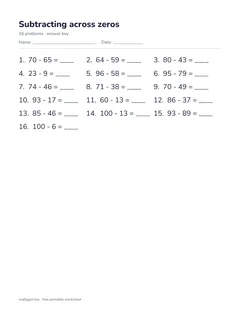
Subtracting across zeros
16 problems · answer key
While it prints: play Subtraction with regrouping

Subtraction with regrouping, explained
Subtraction with regrouping (also called borrowing) is needed when a digit on top is smaller than the digit below it. In 52 − 27 there are 2 ones and we need to take away 7. So we regroup: one of the 5 tens is broken into 10 ones, leaving 4 tens and 12 ones. Now 12 − 7 = 5 and 4 − 2 = 2, and the answer is 25. The worked example above shows how to subtract using regrouping one step at a time, and the base-ten picture shows the ten being broken up.
Borrowing across zeros
The hardest kind of problem is borrowing from a zero, as in 403 − 168. There are no tens to borrow from, so first a hundred is broken into 10 tens, then one of those tens into 10 ones: 403 becomes 3 hundreds, 9 tens and 13 ones. Many 3rd and 4th graders get stuck here, which is why this page has a separate worksheet for subtracting across zeros and a setting in the game for it.
When children learn it
Two-digit subtraction with regrouping starts in 2nd grade with place-value strategies (Common Core 2.NBT.B.5), grows to three-digit numbers within 1,000 in 2nd and 3rd grade, and the standard algorithm is expected by 4th grade (4.NBT.B.4). In England the formal column method for subtraction is taught in Year 3.
2 digit subtraction with regrouping: games and worksheets
The trainer gives only problems that need regrouping, written in columns, with keypad answers: double digit subtraction with regrouping first, then triple digit problems in the settings. Subtraction without borrowing, like 68 − 25, is on the within 100 page. Like all our games, it plays online for free. If an answer is wrong, the hint names the step ("2 − 7 doesn't work: borrow 1 ten, 12 − 7 = 5"). The gates runner shows "−18" and "−9" gates for a quicker, mental round. The subtraction with regrouping sheets print on squared grids with an answer key; the "across zeros" sheet is for children who already master the basic case.
A tip for parents
Always check with addition: 25 + 27 should give 52. When a child does the check on their own, they find most mistakes themselves, and that habit matters more than speed.
Questions and answers
Is borrowing the same as regrouping?
Yes. Most US schools say "regrouping" or "trading"; "borrowing" is the older word, and in England many teachers say "exchanging".
What is the most common mistake?
Taking the smaller digit from the bigger one in each column (52 − 27 = 35). The answer is 25.
How do you subtract across zeros?
Borrow from the next non-zero digit: 400 − 156 → 3 hundreds, 9 tens, 10 ones, then subtract: 244.
What grade is subtraction with regrouping?
2nd and 3rd grade, with the standard method by 4th grade. Year 3 in England.