
Addition and subtraction within 10
FreeNo sign-upNo ads in the gamePrint
Kindergarten-Grade 1 · Common Core K.OA.A.2, K.OA.A.5, 1.OA.C.6 · England: Year 1
Step by step
"Adding and taking away within 10" - Count on from the bigger number: 2 + 6 → "6, 7, 8" = 8. Doubles: 3 + 3 = 6, 4 + 4 = 8, 5 + 5 = 10. Taking away: count back, or think addition: 9 − 4 → "4 and what makes 9?" → 5. Ten-pairs: 1 + 9, 2 + 8, 3 + 7, 4 + 6, 5 + 5.

Within 10 · 10 questions · no timer ·
- 1Practice
- 2Speed
- 3Test
- 4Diploma
Worksheets to print
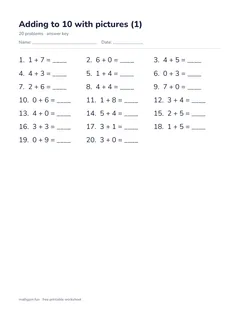
Adding to 10 with pictures
20 problems · answer key
While it prints: play Addition and subtraction within 10
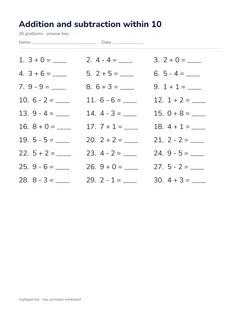
Addition and subtraction within 10
30 problems · answer key
While it prints: play Addition and subtraction within 10
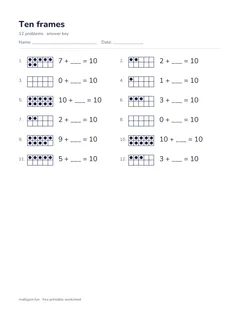
Ten frames
12 problems · answer key
While it prints: play Addition and subtraction within 10

Adding to 10 and subtraction within 10
Adding to 10 and subtraction within 10 are the first real math a child does: 3 + 4, 9 − 2, 5 + 5. In kindergarten the Common Core asks children to solve these with objects and drawings and to know the sums within 5 by heart; in 1st grade they become fluent within 10. In England the same facts belong to Year 1, as "number bonds within 10". This page starts with dots under the numbers, so a 5-year-old can count, and drops them as the answers get quicker.
How children add within 10
First they count everything (one, two, three … seven). Then they count on from the first number (4 … 5, 6, 7). Then they count on from the bigger number, which is faster. Finally the fact is simply known. You can see the stage your child is in by watching their fingers. The game gives time for every stage but rewards the quick answers with a streak, so children move up naturally.
Subtraction within 10 is addition in reverse
For 8 − 3, many children count back three: 7, 6, 5. A better habit is "3 and how many make 8?" That turns every subtraction into an addition fact they already know. The game shows 3 + 5 = 8 and 8 − 3 = 5 one after the other sometimes, so the link becomes obvious.
Games and worksheets for kindergarten and 1st grade
Play the trainer with four big buttons (no reading needed), then switch to Make 10, where children tap pairs that add up to ten. Memory pairs match "6 + 3" with "9". The speed test is for older children who want a record. All of them are free online games. For paper, the adding and subtracting worksheets are the picture worksheet for preschoolers, the 30-problem sheet for 1st graders, or the ten-frame sheet for the "how many more make 10?" question.
A tip for parents
Play "hide and count" with ten small toys: hide some under a cup and ask how many are hidden. If 6 are visible, 4 are under the cup. It is subtraction within 10 without a single written number, and children ask to play it again.
Questions and answers
At what age do kids add within 10?
Usually at 5-6, in kindergarten (US) or Year 1 (England).
Is it okay to use fingers?
Yes, at the start. The goal is to move from counting to knowing; games with a streak help with that.
What is a ten frame?
A box of 2 rows of 5 spaces. Filling it with counters shows how many more make 10.