
Times tables 1-20: multiplication table and games
FreeNo sign-upNo ads in the gamePrint
Grades 2-4 · Common Core 3.OA.C.7 · England: Years 2-4, Multiplication Tables Check in Year 4
The table
| · | 1 | 2 | 3 | 4 | 5 | 6 | 7 | 8 | 9 | 10 | 11 | 12 |
|---|---|---|---|---|---|---|---|---|---|---|---|---|
| 1 | 1 | 2 | 3 | 4 | 5 | 6 | 7 | 8 | 9 | 10 | 11 | 12 |
| 2 | 2 | 4 | 6 | 8 | 10 | 12 | 14 | 16 | 18 | 20 | 22 | 24 |
| 3 | 3 | 6 | 9 | 12 | 15 | 18 | 21 | 24 | 27 | 30 | 33 | 36 |
| 4 | 4 | 8 | 12 | 16 | 20 | 24 | 28 | 32 | 36 | 40 | 44 | 48 |
| 5 | 5 | 10 | 15 | 20 | 25 | 30 | 35 | 40 | 45 | 50 | 55 | 60 |
| 6 | 6 | 12 | 18 | 24 | 30 | 36 | 42 | 48 | 54 | 60 | 66 | 72 |
| 7 | 7 | 14 | 21 | 28 | 35 | 42 | 49 | 56 | 63 | 70 | 77 | 84 |
| 8 | 8 | 16 | 24 | 32 | 40 | 48 | 56 | 64 | 72 | 80 | 88 | 96 |
| 9 | 9 | 18 | 27 | 36 | 45 | 54 | 63 | 72 | 81 | 90 | 99 | 108 |
| 10 | 10 | 20 | 30 | 40 | 50 | 60 | 70 | 80 | 90 | 100 | 110 | 120 |
| 11 | 11 | 22 | 33 | 44 | 55 | 66 | 77 | 88 | 99 | 110 | 121 | 132 |
| 12 | 12 | 24 | 36 | 48 | 60 | 72 | 84 | 96 | 108 | 120 | 132 | 144 |

All tables 2-12 · 10 questions · no timer ·
Pages
1 times table games
5 games
2 times table games
6 games
3 times table games
6 games
4 times table games
6 games
5 times table games
6 games
6 times table games
6 games
7 times table games
6 games
8 times table games
6 games
9 times table games
6 games
10 times table games
6 games
11 times table games
6 games
12 times table games
6 games
13 times table games
6 games
14 times table games
6 games
15 times table games
6 games
16 times table games
6 games
17 times table games
6 games
18 times table games
6 games
19 times table games
6 games
20 times table games
6 games
Mixed times tables
5 games
- 1Practice
- 2Speed
- 3Test
- 4Diploma
Worksheets to print
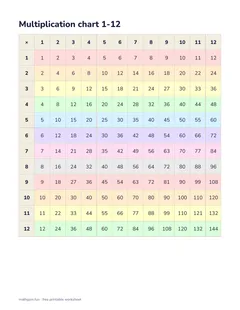
Multiplication chart 1-12
12 problems · answer key
While it prints: play Times tables games
Blank multiplication chart
12 problems · answer key
While it prints: play Times tables games
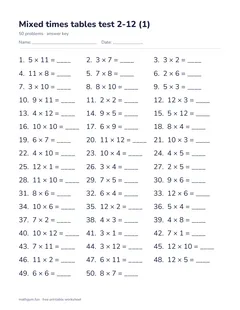
Mixed times tables test 2-12
50 problems · answer key
While it prints: play Times tables games


The times tables from 1 to 12
The multiplication table above shows all times tables from 1 to 12 at once: find one number on the left, one on top, and the answer is where the row and the column meet. 7 × 8 is in row 7, column 8: 56. It is an interactive multiplication chart: tap a number to see its fact, or press Big view for a large chart on the whiteboard. Children learn the times tables in 2nd to 4th grade, and by the end of 3rd grade the Common Core expects them to know all products of two one-digit numbers from memory. In England all tables up to 12 × 12 are due by the end of Year 4, when pupils take the Multiplication Tables Check. After 12 come the 13 to 20 times tables, each with its own page through 20 × 12, for children who want a bigger challenge.
In what order should kids learn the times tables?
Start with the tables that have a pattern a child can see. The two times table is doubling, the ten times table moves every digit one place to the left, and the five times table ends in 5 or 0. Next come three, four and eight: the four times table is the two times table doubled and the eight times table is the four times table doubled. Last are the six, seven and nine times tables, plus 11 and 12. The good news is that each new table is shorter than it looks. 3 × 8 is the same as 8 × 3, so a child who already knows the 2-6 and 8-10 times tables finds only 7 × 7, 7 × 11 and 7 × 12 new in the 7 times table. The whole 12 × 12 multiplication table has 144 cells, but only 78 different facts.
Times tables games that make the facts stick
Reading the chart is not the same as knowing it. A fact is learned when the answer comes in about three seconds, without counting. That is what the times tables games here train (maths games or "x tables" games, as they say in the UK), and along the way children start to see the multiples of each number: 6, 12, 18, 24 … The trainer works like a deck of online flash cards: it asks one fact at a time and brings a missed fact back two or three questions later. The speed test is a timed multiplication quiz and drill, a mad minute on the screen: a 60-second round against your own best score, so a child competes with yesterday, not with classmates. The gates runner turns the same facts into a running game, and memory pairs match "6 × 8" with "48". After every round the "work on these" list shows the facts that were slow or wrong, and one tap prints a worksheet of just those. These fun multiplication activities online suit KS2 pupils too, and short daily rounds build fluency.
Multiplication facts to practice first
If time is short, practice the facts most children find hardest: 6 × 7, 6 × 8, 7 × 7, 7 × 8, 8 × 8 and 9 × 7 (42, 48, 49, 56, 64, 63). Ten minutes a day for a few weeks beats one long session before a test.
A printable multiplication chart and worksheets
Print the multiplication chart for the fridge or the homework folder, and the blank chart for a self-test: a child who can fill in all 144 cells knows the times tables. The mixed times tables test gives two practice sheets of 50 questions with an answer key. Each table page below also has its own times table sheet, and the worksheet generator makes a new set every time.
Questions and answers
What is the fastest way to learn the times tables?
A few minutes every day, starting with 2, 5 and 10, using the turn-around rule (3 × 8 = 8 × 3) and practicing only the facts that are still slow. The speed test shows the progress.
Should kids learn the times tables up to 10 or 12?
The Common Core asks for one-digit facts (up to 9 × 9 and 10s) in 3rd grade. Many US schools and the England curriculum go to 12 × 12. Both are on this site; the settings let you choose 1-10 or 1-12.
What is the Multiplication Tables Check (MTC)?
A short online check in England for pupils in Year 4: 25 multiplication questions from the tables up to 12 × 12, with 6 seconds per question. The mixed speed test here trains the same skill.
How can I tell my child knows a table?
When they answer the facts of that table in random order, about 3 seconds each, without counting on fingers. The test at the end of each table page checks exactly that and gives a diploma.
Is there a multiplication chart to print?
Yes: download the color chart, the black-and-white chart or a blank chart to fill in above.