
Division games
FreeNo sign-upNo ads in the gamePrint
Grades 3-5 · Common Core 3.OA.B.6, 3.OA.C.7, 4.NBT.B.6, 5.NBT.B.6 · England: Years 3-6

Division facts 2-10 · 10 questions · no timer ·
Pages
- 1Practice
- 2Speed
- 3Test
- 4Diploma
Worksheets to print
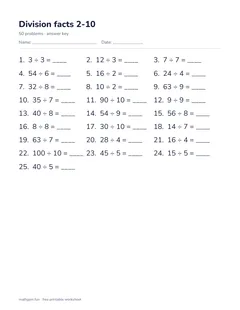
Division facts 2-10
50 problems · answer key
While it prints: play Division games
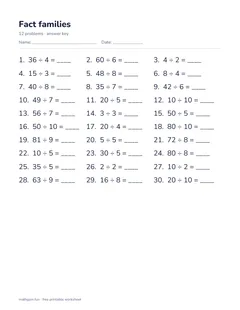
Fact families
12 problems · answer key
While it prints: play Division games
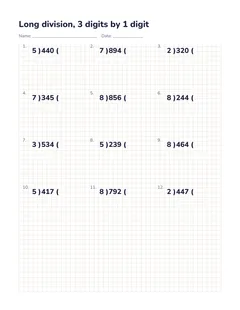
Long division, 3 digits by 1 digit
12 problems · answer key
While it prints: play Division games

Division games from sharing to long division
Division starts with sharing: 12 cookies on 3 plates, how many on each? Basic division means simple problems like this one. In 3rd grade children learn that this is 12 ÷ 3 = 4 and that it is the same fact as 3 × 4 = 12 read backwards. The Common Core calls this "division as an unknown-factor problem" and expects children to know the division facts within 100 from memory by the end of 3rd grade. In 4th and 5th grade they divide bigger numbers, first with strategies, then with long division. These division games follow the same path: facts first, then the written method.
Multiplication and division games belong together
A child who knows 7 × 8 = 56 also knows 56 ÷ 7 = 8 and 56 ÷ 8 = 7, if someone shows them the link. That is why the division facts here are grouped in fact families, and why the games sometimes put "7 × ? = 56" next to "56 ÷ 7". If division feels hard, the reason is usually a times table that is not secure yet: practice the table first, then come back. The fact family worksheet prints the triangles (7, 8 and 56) with the four facts to fill in.
Two meanings of division
12 ÷ 3 can mean "share 12 into 3 groups" (how many in each group?) or "how many groups of 3 are in 12?". Both give 4. The game pictures switch between plates (sharing) and bags of 3 (grouping) so children meet both.
Which division game to play
- 3rd grade (England Years 3-4): Division facts, starting with the easy ones, ÷ 2, ÷ 5 and ÷ 10, then the others.
- 4th grade: mixed division facts in random order in the speed test, and three-digit by single digit division with remainders.
- 5th grade (England Years 5-6): long division, also with two-digit divisors.
Division games online, free and printable
All division games run in the browser on a phone, a tablet or a Chromebook, with a keypad on the screen. Missed facts come back until they are right three times in a row, and the end screen lists the ones to work on. Teachers can use projector mode for a fun whole-class round with Team A and Team B, and every skill prints as a worksheet with an answer key: the three division sheets above are facts, fact families and long division. Looking for a division chart? The division facts page has the division math chart with every fact from 1 to 12, ready to print. In UK maths, children divide with the same steps in Years 3 to 6.
A tip for parents
Make division real at dinner: "We have 18 strawberries for 3 people. How many each?" Then turn it around: "If each person gets 6, how many did we have?" That switch between division and multiplication is the whole idea of a fact family.
Questions and answers
What grade learns division?
3rd grade starts division facts; 4th grade divides up to four-digit numbers by one-digit numbers; 5th grade uses two-digit divisors.
Should my child know the times tables before division?
Yes, at least the tables being divided by. 56 ÷ 7 is quick only when 7 × 8 = 56 is known.
What is a fact family?
Three numbers linked by multiplication and division: 7, 8 and 56 give 7 × 8, 8 × 7, 56 ÷ 7 and 56 ÷ 8.
What is the difference between short and long division?
In England, short division is the written method for one-digit divisors; long division writes every subtraction step and is used for two-digit divisors. In the US both are usually called long division.