
Telling time games
Hours · Half hours · Quarter hours · 5 minutes · 1 minute
FreeNo sign-upNo ads in the gamePrint
Grades 1-3 · Common Core 1.MD.B.3, 2.MD.C.7, 3.MD.A.1 · England: Years 1-3
Step by step
"How to read a clock: 7:25"
- Look at the short hand (the hour hand). It is just past the 7, so the hour is 7.
- Look at the long hand (the minute hand). It points at the 5.
- Count the minutes by fives: each number on the clock is 5 minutes, so 5 × 5 = 25.
- Say the time: 7:25, "seven twenty-five" or "twenty-five past seven".
- Special times: hand on 12 = "o'clock" (3:00) · on 6 = "half past" (3:30) · on 3 = "quarter past" (3:15) · on 9 = "quarter to" the next hour (8:45 = quarter to 9).

Hours · 10 questions · no timer ·
- 1Practice
- 2Test
- 3Diploma
Worksheets to print
Telling time to the hour and half hour
12 problems · answer key
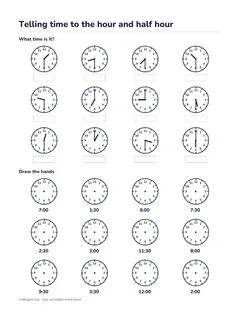
While it prints: play Telling time games
Telling time to 5 minutes
16 problems · answer key
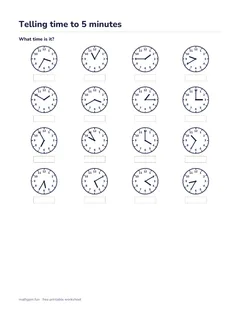
While it prints: play Telling time games
Make your own clock
answer key
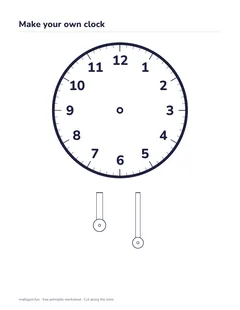
While it prints: play Telling time games

Telling time games for kids
Reading an analog clock is one of the trickiest things children learn in elementary school: two hands, two kinds of numbers, and words like "quarter to". These telling time games break it into steps. First the hour hand alone, then half past, then quarter past and quarter to, then every 5 minutes, and finally the exact minute. In the main game the child drags the hands to show a time; in the second one they read a clock and pick the right answer.
When children learn to tell time
Following the Common Core, 1st graders tell and write time in hours and half hours, 2nd graders to the nearest five minutes using a.m. and p.m., and 3rd graders to the nearest minute, including how much time has passed (elapsed time). In England, telling the time runs through KS1 into KS2: Year 1 starts with o'clock and half past, Year 2 adds quarter past, quarter to and five-minute times, and Year 3 reads clocks to the minute, including Roman numerals and 12- and 24-hour times.
The two hands
Children mix up the hands more than anything else. The short hand shows the hour and moves slowly; the long hand shows the minutes and goes all the way round in an hour. At 7:25 the hour hand is between 7 and 8 - not on 7 - which is a good way to check the reading.
Clock games and worksheets
Choose the level with the chips: hours, half hours, quarter hours, 5 minutes or 1 minute. The game says each time in words and digits ("half past 3", 3:30), so children learn both ways. Print the telling time practice sheets for paper, and the "make your own clock" sheet to build a clock with moving hands - of all telling time activities, it is the best one for the first week.
A tip for parents
Teaching time works best with the real day: "We leave at quarter past 8 - where will the hands be?" A wall clock in the kitchen, at a child's eye level, helps more than any app.
Questions and answers
At what age do kids learn to tell time?
Hours and half hours at 6-7 (1st grade), 5-minute times at 7-8 (2nd grade), the exact minute at 8-9 (3rd grade).
What does "quarter to 9" mean?
15 minutes before 9 o'clock: 8:45. The minute hand points at the 9.
Why learn an analog clock if phones show digital time?
Analog clocks are on school walls and in tests, and they show time as a part of an hour, which helps with fractions and elapsed time.