
Addition games and subtraction games
FreeNo sign-upNo ads in the gamePrint
Kindergarten-Grade 4 · Common Core K.OA, 1.OA, 2.OA, 2.NBT, 4.NBT.B.4 · England: Years 1-3

Addition & subtraction within 20 · 10 questions · no timer ·
Pages
- 1none on the hub
Worksheets to print
Addition and subtraction within 20
40 problems · answer key
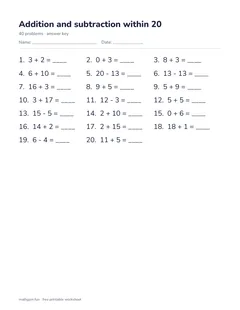
While it prints: play Addition and subtraction games
Two-digit addition with regrouping
24 problems · answer key
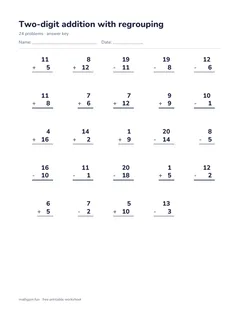
While it prints: play Addition and subtraction games
Two-digit subtraction with regrouping
24 problems · answer key
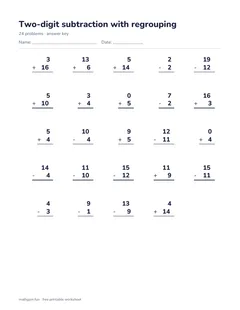
While it prints: play Addition and subtraction games

Addition games and subtraction games in the order school teaches them
Addition games and subtraction games train the first big jobs of elementary math, which grow in steps. In kindergarten children add and subtract within 10 with fingers and objects. In 1st grade they work within 20 and learn to make 10. By the end of 2nd grade the Common Core expects every sum of two one-digit numbers from memory, fluent adding and subtracting within 100, and first steps within 1,000. The standard written method with regrouping is due by 4th grade. The addition and subtraction games on this page follow those steps; each tile above is one step.
Why play adding games instead of doing a worksheet?
A worksheet shows whether a child can get the answer. A game shows how fast it comes and gives a reason to do twenty more. In the gates runner the crowd grows with "+8" and shrinks with "−3", so a child sees what the numbers do. In Make 10 they hunt for pairs like 6 and 4. The trainer brings back every missed fact a few questions later, so the practice goes where it is needed. And when you do want paper, every page prints the same problems as a worksheet with an answer key; the three addition and subtraction sheets below (within 20, and addition and subtraction sheets with regrouping) are a good start.
Addition facts, doubles and the "think addition" trick
Most children learn a few anchor facts first: doubles (6 + 6 = 12), near doubles (6 + 7 = one more than 12), and the pairs that make 10. For subtraction, the best strategy is to think addition: 13 − 5 is "5 plus what makes 13?" The games mix addition and subtraction on purpose, so children see that 8 + 5 = 13 and 13 − 5 = 8 belong together. That link is what builds fluency.
Which game for which age?
- Ages 5-6 (kindergarten, England Year 1): Within 10 (single digit addition and subtraction) and Number bonds, with four big answer buttons.
- Ages 6-7 (1st grade): Within 20, then Make 10 for the bridge through ten (8 + 5 = 8 + 2 + 3).
- Ages 7-8 (2nd grade): Within 100 (adding by 10s, then 2-digit adding without regrouping) and Addition with regrouping.
- Ages 8-10 (3rd-4th grade): Subtraction with regrouping, also with three-digit numbers.
Free, no sign-up, works in class
All addition and subtraction games are free and interactive, run in the browser and need no account. Teachers can show any of them in projector mode with big digits and team scores, or send a share link so pupils play the same range at home. In UK maths, addition and subtraction follow the same steps as number bonds and column addition in Years 1 to 3 (KS1 and the start of KS2). The EYFS addition games for Reception children are the Within 10 and Kindergarten pages.
Questions and answers
What age should a child add within 20?
Most children work within 20 in 1st grade (age 6-7) and know the facts by heart by the end of 2nd grade.
What is regrouping?
The US school word for carrying and borrowing: when the ones add up to 10 or more, ten ones become one ten (carrying); when you can't take away, one ten becomes ten ones (borrowing).
Should addition and subtraction be practiced together?
Yes. They are two views of the same fact family (8 + 5 = 13, 13 − 5 = 8), so mixing them helps both.
Are there printable addition worksheets?
Yes: each page has PDFs with an answer key, and the worksheets page has a generator.