
How to do long division, step by step
FreeNo sign-upNo ads in the gamePrint
Grades 4-6 · Common Core 4.NBT.B.6, 5.NBT.B.6, 6.NS.B.2 (standard algorithm) · England: Years 5-6
Step by step
- Example 1: 845 ÷ 5
- Divide: 8 ÷ 5 = 1 r 3 (5 goes into 8 once). Write 1 above the 8.
- Multiply: 1 × 5 = 5. Write 5 under the 8.
- Subtract: 8 − 5 = 3.
- Bring down the 4: 34.
- Divide: 34 ÷ 5 = 6 r 4. Write 6 above the 4. Multiply: 6 × 5 = 30. Subtract: 34 − 30 = 4.
- Bring down the 5: 45. Divide: 45 ÷ 5 = 9. Write 9. Multiply: 9 × 5 = 45. Subtract: 0.
- Answer: 845 ÷ 5 = 169. Check: 169 × 5 = 845.
- Example 2 (with a remainder): 734 ÷ 6
- 7 ÷ 6 = 1 r 1, 1 × 6 = 6, 7 − 6 = 1. Bring down 3: 13.
- 13 ÷ 6 = 2 r 1, 2 × 6 = 12, 13 − 12 = 1. Bring down 4: 14.
- 14 ÷ 6 = 2 r 2, 2 × 6 = 12, 14 − 12 = 2. Nothing left to bring down.
- Answer: 734 ÷ 6 = 122 r 2. Check: 122 × 6 + 2 = 734.
- Example 3 (two-digit divisor, 5th grade): 864 ÷ 24
- 8 ÷ 24 doesn't work, so use 86: 86 ÷ 24 = 3 r 14 (because 3 × 24 = 72). 86 − 72 = 14.
- Bring down 4: 144. 144 ÷ 24 = 6 (6 × 24 = 144). 144 − 144 = 0.
- Answer: 864 ÷ 24 = 36.

3-digit ÷ 1-digit · 5 problems · no remainders ·
- 1Practice
- 2Test
- 3Diploma
Worksheets to print
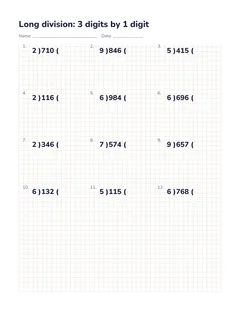
Long division: 3 digits by 1 digit
12 problems · answer key
While it prints: play Long division
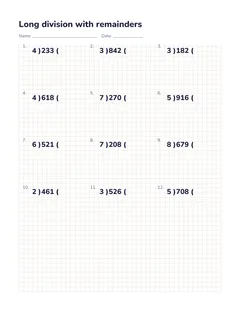
Long division with remainders
12 problems · answer key
While it prints: play Long division
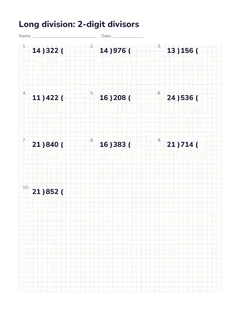
Long division: 2-digit divisors
10 problems · answer key
While it prints: play Long division

Long division steps: divide, multiply, subtract, bring down
Long division, explained simply, is a way to divide big numbers by hand, one digit at a time. It repeats four steps: divide, multiply, subtract, bring down. In 845 ÷ 5, you first ask how many 5s fit into 8 (one), write 1 on top, take away 5, and bring down the next digit. The worked example above shows every step with the real numbers, and the answer 169 can be checked by multiplying back: 169 × 5 = 845.
When children learn long division
In the Common Core, 4th graders divide numbers up to four digits by one-digit numbers using place value and the link to multiplication, and 5th graders move to two-digit divisors. The standard long division algorithm itself is required in 6th grade, although many schools teach it in 4th or 5th. In England, Year 5 uses short division for one-digit divisors and Year 6 learns long division for two-digit divisors. In KS2 the bracket layout is often called the bus stop method.
Remainders
To find the quotient and remainder using long division, go on until no digits are left to bring down. When the last subtraction does not give 0, what is left is the remainder: 734 ÷ 6 = 122 r 2. The remainder must always be smaller than the divisor; if it is equal to or greater than the divisor, the quotient digit was too small.
A long division game that checks each step
The column calculator works online in any browser. It writes the problem in the bracket layout and asks for one digit at a time. A wrong digit turns red with a hint ("34 ÷ 5 = 6 r 4: write 6, bring down the 5"), and "Show me" plays the step. Start with easy long division: three-digit numbers and one-digit divisors without remainders. Then turn remainders on, and finally divide by double digits. Each long division sheet prints on squared paper, so the columns line up, with an answer key.
A tip for parents
When teaching long division at home, remember that it fails most often because of a slow times-table fact, not because of the method. If your child stops at "34 ÷ 5", spend a few minutes on the 5 times table first, and the long division will flow.
Questions and answers
What is the meaning of long division?
A written method to divide a big number by a smaller one in small steps, one digit at a time, with the answer (quotient) on top.
What are the steps of long division?
Divide, multiply, subtract, bring down - and repeat until no digits are left.
What grade learns long division?
4th and 5th grade work with division strategies; the standard algorithm is required in 6th grade in the Common Core. In England, Year 5 (short division) and Year 6 (long division).
How do I check a long division answer?
Multiply the quotient by the divisor and add the remainder: 122 × 6 + 2 = 734.
What if the first digit is smaller than the divisor?
Use the first two digits: in 864 ÷ 24, start with 86.