
Number bonds to 10 and 20
FreeNo sign-upNo ads in the gamePrint
Kindergarten-Grade 1 · Common Core K.OA.A.3, K.OA.A.4, 1.OA.C.6 · England: Years 1-2
Step by step
| 0 + 10 | = | 10 |
|---|---|---|
| 1 + 9 | = | 10 |
| 2 + 8 | = | 10 |
| 3 + 7 | = | 10 |
| 4 + 6 | = | 10 |
| 5 + 5 | = | 10 |
| 6 + 4 | = | 10 |
| 7 + 3 | = | 10 |
| 8 + 2 | = | 10 |
| 9 + 1 | = | 10 |
| 10 + 0 | = | 10 |
"Number bonds of 10"
"Number bonds of 20"

Make 10 · 8 pairs ·
- 1Practice
- 2Test
- 3Diploma
Worksheets to print
Number bonds to 10
20 problems · answer key
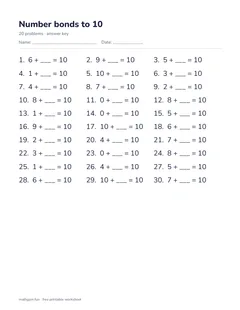
While it prints: play Number bonds to 10 and 20
Number bonds to 20
30 problems · answer key
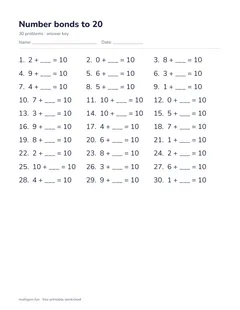
While it prints: play Number bonds to 10 and 20
Make 10 rainbow
answer key
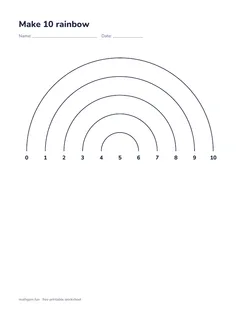
While it prints: play Number bonds to 10 and 20


What are number bonds?
Number bonds, explained simply, are pairs of numbers that make a given number. One example of a number bond: 7 and 3 make 10. The number bonds of 10 are 0 + 10, 1 + 9, 2 + 8, 3 + 7, 4 + 6 and 5 + 5 (and the same pairs turned around). The number bonds of 20 follow from them: 11 + 9, 12 + 8, 13 + 7 and so on. Children see them as a part-whole diagram: the whole on top, the two parts below. Knowing them by heart is one of the most useful things in early math, because almost every later strategy uses them.
Why bonds to 10 matter so much
The Common Core asks kindergarteners to find, for any number from 1 to 9, the number that makes 10 (K.OA.A.4), and 1st graders use "making ten" as a strategy to add within 20. 8 + 5 becomes 8 + 2 + 3 = 13 only if a child knows that 8 and 2 make 10 instantly. In England number bonds within 10 and 20 are part of Year 1, and Year 2 extends them to the tens of 100 (30 + 70). Later the same idea gives 100 − 37 or the change from a dollar.
Bonds and subtraction
Every bond is also two subtraction facts: 7 + 3 = 10 means 10 − 3 = 7 and 10 − 7 = 3. The table above shows both columns, and the trainer asks "10 − ? = 4" as well as "6 + ? = 10".
Make 10 and other number bond games
Make 10 is the main number bonds game online here: a board of 16 numbers, and the child taps two that add up to 10. Right pairs turn green and stay, and a clock runs until the whole board is green. Make 20 does the same for bonds of 20. Memory pairs match "3" with "7" under a big "10", and the trainer asks for the missing number. Print the part-whole sheet for 5- and 6-year-olds and the number bonds to twenty worksheet for 1st graders.
A tip for parents
Use your hands: hold up 10 fingers, fold some down and ask "how many are down?" Of all number bond activities it needs the least: play it in the car or the supermarket queue, and it practices exactly the bonds of 10.
Questions and answers
What are the number bonds to 10?
0 + 10, 1 + 9, 2 + 8, 3 + 7, 4 + 6, 5 + 5, and the same pairs the other way round.
What are number bonds to 20?
Pairs that make 20: 0 + 20, 1 + 19 … 10 + 10. Each one is a bond of 10 with a ten added.
What age learns number bonds?
Bonds to 10 at 5-6 (kindergarten, England Year 1), bonds to 20 at 6-7 (1st grade, Years 1-2).
What is a part-whole model?
A drawing with the whole number in one circle and its two parts in two circles below it.